
Safer, easier pallet wrapping for your team.
In a busy warehouse, pallets are wrapped hundreds of times a day, by dozens of people across every shift. By hand, that means pulling film, bending and walking round every pallet; on a wrapper, lifting heavy machine reels and re-threading broken film. We measure how your teams wrap today, find where the effort and the risk sit, and prove a safer, faster way on your own line.
Measured on your loads, your wrappers and your shifts, then rolled out site by site.
Book your free benchmark
We’ll visit, watch how your team wraps today and show you where effort and time could be saved. It’s free, with no obligation, and your trial order is sale-or-return.
We’ll only use your details to respond to your enquiry. See our privacy policy.
Prefer to talk? Call 01795 430 064.
Hand or machine, the wrong film makes every shift harder.
By hand, it means more pulling and more passes round every pallet. On a wrapper, it means more breaks, more re-threading and more heavy reels to lift.
The cost that lands on your team
Strain, shift after shift
Pulling film by hand, bending, and lifting 16kg machine reels takes its toll on backs, shoulders and arms.
Time off the line
Every reel change and film break stops production, and every injury means cover, overtime or lost output.
Multiplied across every shift and site
Agency staff, new starters and dozens of operators each wrap their own way. Across hundreds of people, a little strain and a few lost minutes per pallet soon add up.
What your benchmark measures for your team
Where the effort, the time and the risk sit in your wrapping today. A confectionery manufacturer cut 41 reel changes a week and gained more than five hours of production every week after its benchmark.
| We measure | What it tells you |
|---|---|
| Reel changes | How often your team stops to change a machine reel or hand roll, per shift and per week |
| Roll handling | What your operators lift on and off the wrapper, and how often |
| Wrapping time | How long each pallet takes, by machine or by hand |
| Hand-wrapping effort | How much stretching your operators do by hand, and for how long |
| Film breaks | How often film snaps, and the time lost re-threading |
| Consistency between shifts | Whether every operator wraps every pallet to the same standard |
Free, with no obligation. Most benchmarks take a single visit.
- On your site, on your own line
- Your current film benchmarked first
- Alternatives trialled side by side
- A written report on cost and stability
- Sale-or-return trial order
The safest change is often the simplest. The right film on the right settings can remove a lot of pulling, lifting and reel changing, without changing how your team works. Our measured findings can feed straight into your own manual handling risk assessment.
Wrapping by hand
Every operator wraps a different pallet. When pallets are wrapped by hand, every member of your team does it their own way: one pulls the film tighter, another puts extra layers on the top, another leaves the middle or the base light. Some loads end up over-wrapped, wasting film; others are under-wrapped and at risk in transit. A wrapper with a settings lock wraps every pallet to the same recipe, whoever is on shift.
The stretch is built in
Pre-stretched hand film is stretched at the factory, so operators don’t do the stretching by hand, and wrapping takes far less effort.
Half as many roll changes
600m on every roll, against 300m on a standard hand roll, so your team changes rolls half as often.
Less pulling, less strain
A thinner, pre-stretched film holds the load with less pulling, so arms, shoulders and backs work less hard.
Something to hold
Extended cores give operators a handle at each end of the roll, instead of gripping the film itself.
Safe, consistent wrapping
We show your team how to wrap safely and consistently by hand, with a simple standard for the layers at the base, the middle and the top, so every operator wraps the same pallet.
Less time bent over
Fewer roll changes and less effort mean less time bending and walking backwards round loads, where trips happen.
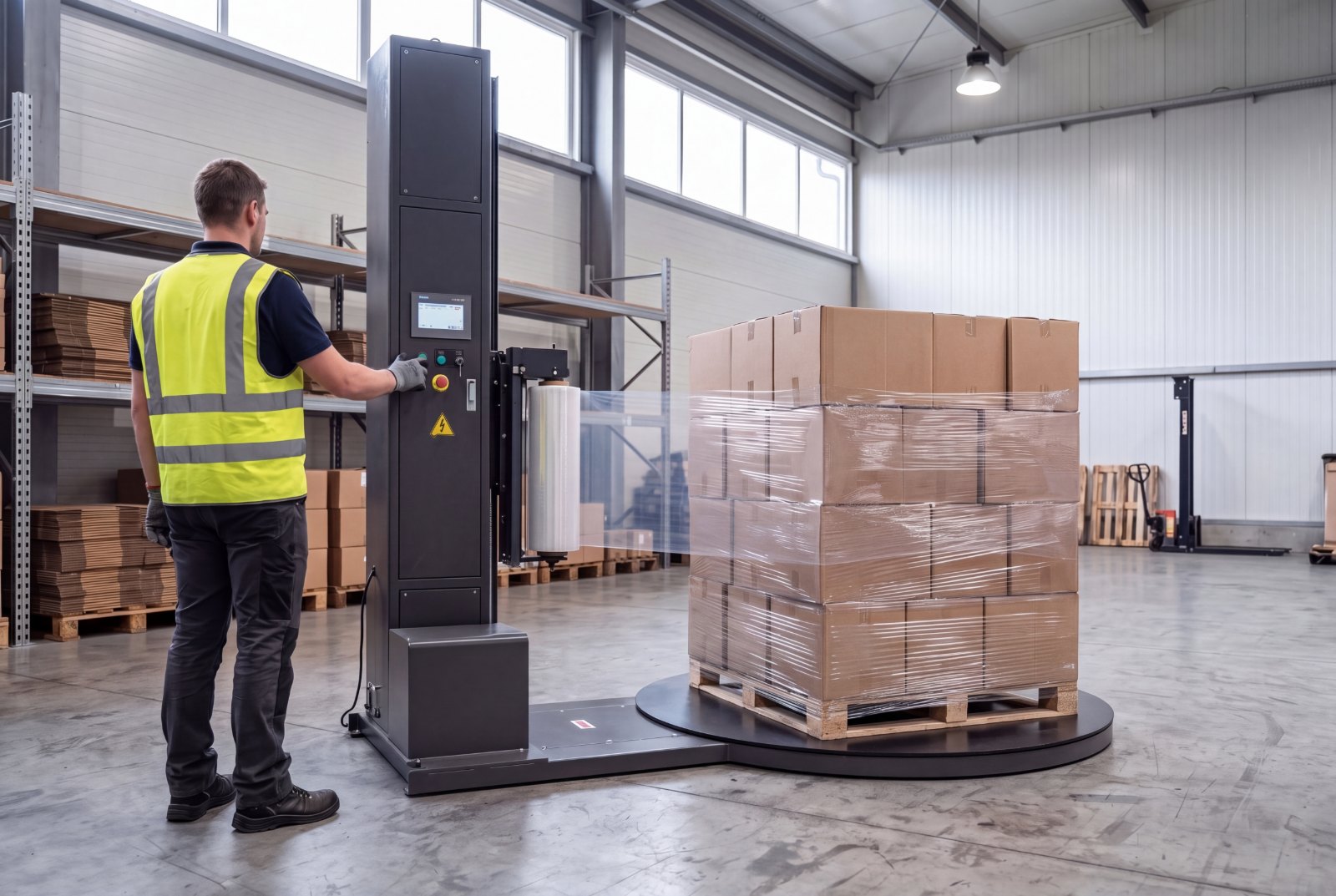
Wrapping on a machine
When the film or the settings are wrong: film breaks mid-wrap and has to be re-threaded, often in a hurry. Too little tension leaves loads loose, so they lean or shift in transit; too much crushes cartons and wastes film. And every machine reel change means lifting a reel that can weigh 16kg and stopping the line. See what that does to your loads.
How the right wrapper and film take the strain off your team:
No more walking pallets round
The turntable turns the load, so nobody walks backwards round every pallet pulling film.
The machine does the stretching
300% powered pre-stretch comes as standard on INNOV8, so operators aren’t stretching film by hand.
Fewer reel changes
Film stretched by the machine goes further, so rolls are lifted and changed less often.
The same wrap, whoever’s on shift
A settings lock keeps your commissioned recipe exactly as signed off, so every pallet is wrapped the same.
Tension held for you
A load cell measures film tension in real time and holds it constant, so nobody is adjusting it by hand.
Loads on with a pallet truck
A loading ramp comes as standard, so pallets go on with a pallet truck, and it runs from a normal 3-pin plug.
See the INNOV8 range: delivered and installed by our own technicians in around two weeks, with four ways to buy, including zero money down. Every pallet is measured live by VisionFlex Cloud, with a summary report to your management team at the end of every working day. Not every site needs a wrapper. If you only wrap a few pallets a day, pre-stretched hand film may be the better answer, and we’ll tell you honestly.
Who it helps
From the operator on the wrapper to the manager signing off the risk assessment.
Operators
Less lifting, less pulling and fewer stoppages, every shift.
Shift and team leaders
One simple standard that agency staff and new starters can follow from day one.
Health and safety managers
Measured findings to support your manual handling risk assessments, site by site.
Operations and site directors
The same standard on every shift and every site, with usage reported site by site.
Running several sites? We hold stock for you, deliver to every site, and report usage site by site, so your best site’s results become the standard everywhere.
Why it matters
17% of reported injuries at work come from handling, lifting or carrying, and 30% from slips, trips and falls.
Wrapping pallets involves both: pulling, lifting and walking backwards round loads, shift after shift. HSE also warns that fatigue brings slower reactions, lack of attention and underestimation of risk, and more than 3.5 million people in the UK work shifts.
Sources: HSE, non-fatal injuries reported under RIDDOR, 2024/25 and HSE, fatigue
Questions we get asked
Is pallet wrapping covered by manual handling rules?
Yes. HSE defines manual handling as lifting, putting down, pushing, pulling, carrying or moving loads, which includes wrapping a pallet by hand. The law requires employers to avoid hazardous manual handling where reasonably practicable, assess what can’t be avoided, and reduce the risk as low as reasonably practicable. See HSE’s guidance.
How does pre-stretched film reduce effort?
It’s stretched at the factory, so your operators don’t do the stretching by hand. A thinner film holds the load with less pulling, and the rolls are twice the length of standard hand film, so they’re changed less often.
How do fewer reel changes help?
On a wrapper, every reel change means lifting a reel that can weigh 16kg, threading the film and stopping the line. A confectionery manufacturer cut 41 reel changes a week and gained more than five hours of production every week.
Will this replace our risk assessment?
No. We measure what’s happening on your line and show which changes would reduce effort and time. Our findings can support your own manual handling risk assessment, which stays yours.
Can you support all of our sites?
Yes. We hold stock for you, deliver to every site, and report usage site by site, so your best site’s results become the standard everywhere. Whether you run one site or fifty, it starts the same way: a conversation about how you wrap today.
What does the benchmark cost?
Nothing. It’s free, with no obligation, and your trial order is sale-or-return.
Can a wrapper reduce manual handling?
Yes. A semi-automatic wrapper takes the walking and pulling out of the job. INNOV8 wrappers are specified by the people who supply the film, and a settings lock keeps every pallet the same, whoever is on shift.
Make wrapping easier for your team.
Book a free benchmark and we’ll measure how your team wraps today, then trial a safer, faster way side by side.