
Pay less per pallet, not just per roll.
The cost of wrapping hides in every pallet you send, across every shift and every site: film you didn’t need, time on the wrapper, and loads that fail on the road. We measure what every pallet really costs to wrap, by hand and by machine, then prove a lower cost per pallet on your own line.
Film per pallet, wrapping time, failed loads and Plastic Packaging Tax, measured on your loads and rolled out site by site.
Book your free benchmark
We’ll visit, measure what every pallet costs you to wrap today and show you where the savings are. It’s free, with no obligation, and your trial order is sale-or-return.
We’ll only use your details to respond to your enquiry. See our privacy policy.
Prefer to talk? Call 01795 430 064.
The cheapest roll is rarely the cheapest pallet.
Get the wrap right and you pay less for film, less for labour and less for loads that fail.
Where the money really goes
Plastic you didn’t need
Over-wrapping, low pre-stretch and every operator wrapping differently mean paying for film that does no work.
Pallets that fail
One damaged or collapsed load can wipe out the savings from a cheaper roll many times over.
Time on the wrapper
Reel changes, film breaks and re-wraps are paid labour and lost output, on every shift.
What your benchmark measures
Everything that adds up to what a pallet really costs you, by hand and on the wrapper. A confectionery manufacturer cut its costs by 16% after its benchmark.
| We measure | What it tells you |
|---|---|
| Cost per pallet | The real cost of wrapping each pallet, not the price per roll |
| Film per pallet | Weighed, not estimated, by hand and on the wrapper |
| Pre-stretch | How far your film is stretched, and your wrap pattern: is the film doing the work you’re paying for? |
| Time and reel changes | Wrapping time, reel changes and downtime on every shift |
| Failed loads | Where loads could fail, and what that risks |
| Plastic Packaging Tax | The tax built into the plastic you use |
Free, with no obligation. Most benchmarks take a single visit.
- On your site, on your own line
- Your current film benchmarked first
- Alternatives trialled side by side
- A written report on cost and stability
- Sale-or-return trial order
Cutting film only saves money if the load still arrives. We never cut film at the expense of load stability. Every change is tested on your own pallets, and we’ll tell you if your current film is already right.
Paying for plastic you don’t need
Over-wrapping ‘just in case’
Extra layers at the top and the base add plastic, and cost, to every pallet you send.
Every operator wrapping differently
By hand, one operator wraps tight and another adds layers, so some pallets carry far more film than they need.
Low pre-stretch on the wrapper
Film that isn’t stretched enough means paying for plastic that isn’t doing any work.
The wrong film for the load
Thicker isn’t always stronger. Fiber Film’s reinforced design can cut the plastic on each pallet by up to 60% by weight.
Double-wrapping
Wrapping twice to make up for the wrong film doubles the cost. An animal feed producer stopped double-wrapping after its benchmark.
Tax on every extra kilo
Plastic packaging with less than 30% recycled plastic is taxed at £228.82 per tonne, and that cost is built into film prices.
Who it helps
From the board to the shift on the wrapper.
Finance directors
A measured cost per pallet, and savings you can verify.
Procurement
Like-for-like comparisons on cost per pallet, not price lists.
Operations and site directors
Less downtime, fewer reel changes and one standard on every site.
Sustainability leads
Less plastic per pallet, reported in tonnes.
Running several sites? We hold stock for you, deliver to every site, and report usage site by site, so your best site’s results become the standard everywhere.
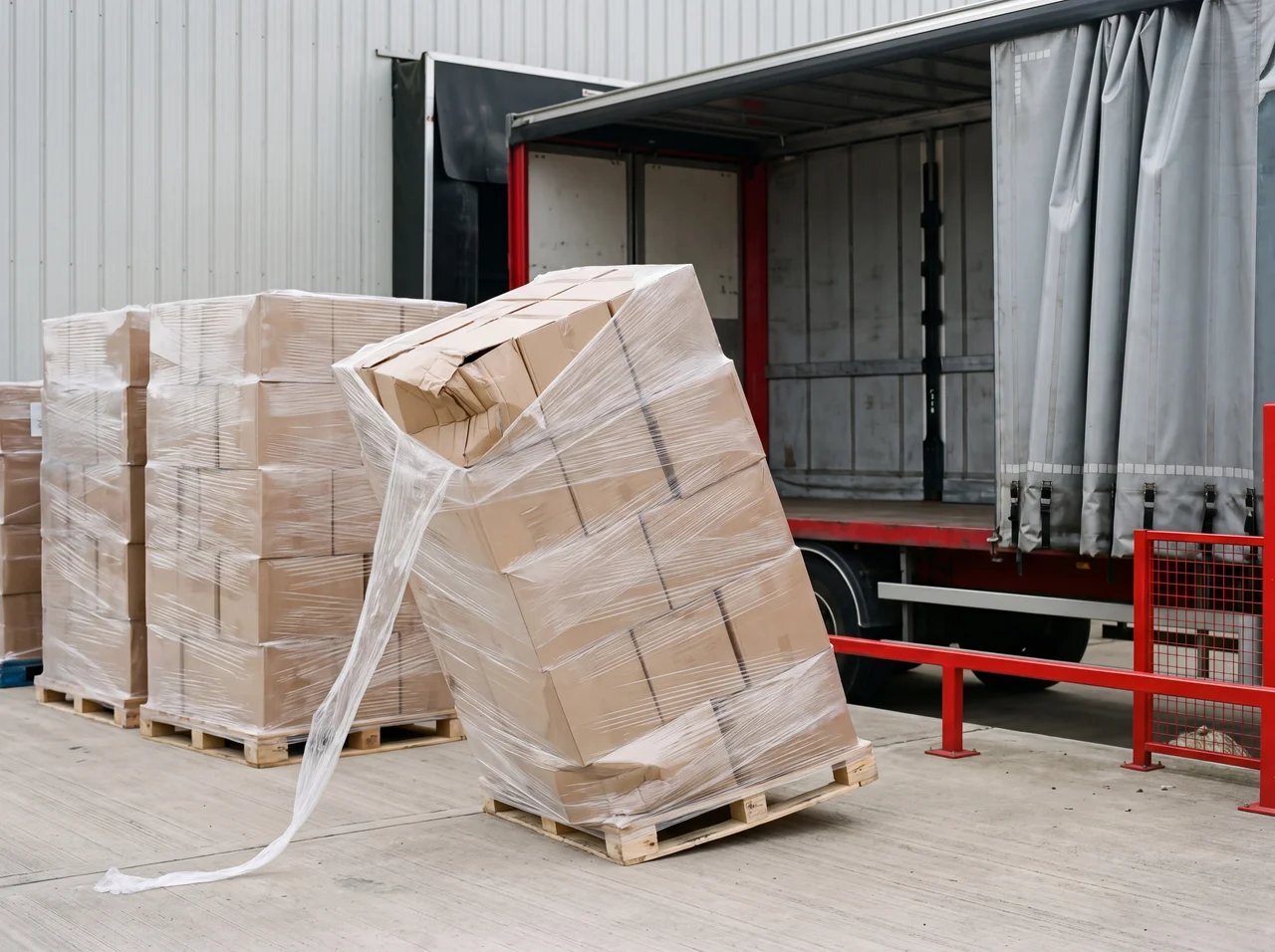
What one fallen pallet really costs
A damaged or collapsed load costs far more than the film that should have held it.
- Damaged stock, written off or sold at a discount
- A second delivery: another trip, another driver, another slot
- Returns, credit notes and disputes with your customer
- Labour to restack, rewrap and check the load
- Knock-on delays across your delivery schedule
- Your reputation with the customer who received it
Price per roll vs cost per pallet
Price per roll is easy to compare. Cost per pallet is what you actually pay.
Not every 16kg roll is 16kg of film. Machine film is usually sold in rolls of around 16kg, but part of that weight is the cardboard core, and in our experience cores range from about 1kg to over 2kg. A heavier core means more cardboard and less film on every roll, so a roll can look cheaper while giving you less film. A 16kg roll on a 1kg core carries 15kg of film; on a core of over 2kg, it carries less than 14kg. That’s more than 7% difference in film for the same roll price. Always compare the net film weight and the metres on each roll, or compare cost per pallet, where a heavy core can’t hide.
| Price per roll | Cost per pallet | |
|---|---|---|
| What you compare | The price of a roll of film | What each pallet actually costs to wrap |
| Film used | Not measured | Weighed on your own pallets |
| Core weight | Counted as if it were film | Only the film you use is counted |
| Labour and downtime | Not counted | Wrapping time and reel changes included |
| Failed loads | Not counted | Where loads could fail, and what that risks |
| Plastic Packaging Tax | Hidden in the price | Shown, and reduced |
| Across your sites | Different on every site | One standard, reported site by site |
Plastic Packaging Tax
£228.82 per tonne is charged on plastic packaging with less than 30% recycled plastic, from 1 April 2026.
It’s built into the price you pay for film, so less plastic per pallet means less tax.
Source: GOV.UK, Plastic Packaging Tax
Questions we get asked
Why measure cost per pallet instead of price per roll?
Because a cheaper roll can use more film per pallet, need more reel changes or let loads fail. Cost per pallet includes all of that, so you can compare options fairly.
Why can price per roll be misleading?
Because rolls aren’t all the same. A machine roll is usually around 16kg, but some of that is the cardboard core, and in our experience cores range from about 1kg to over 2kg: a heavier core means less film for the same price. Metres per roll and film thickness vary too. Cost per pallet measures the film you actually use, so none of that can hide.
What does a damaged pallet really cost?
More than most businesses track: the stock itself, a second delivery, credit notes, labour to restack and rewrap, and sometimes the customer relationship. Your benchmark shows where your loads could fail, so you can stop paying for it.
How much could we save?
It depends on your loads and how you wrap today. A confectionery manufacturer cut its costs by 16%, and an animal feed producer stopped double-wrapping altogether. Your benchmark shows your own figures before you change anything.
How does Plastic Packaging Tax affect what we pay?
It’s charged at £228.82 per tonne from 1 April 2026 on plastic packaging with less than 30% recycled plastic, and it’s built into film prices. Using less plastic per pallet, or film with at least 30% recycled content, reduces it. See GOV.UK.
Can we track the cost of every pallet?
Yes, with an INNOV8 wrapper. Every pallet is measured live by VisionFlex Cloud, including film consumption, with a summary report to your management team at the end of every working day.
Can you support all of our sites?
Yes. We hold stock for you, deliver to every site, and report usage site by site, so your best site’s results become the standard everywhere. Whether you run one site or fifty, it starts the same way: a conversation about how you wrap today.
What does the benchmark cost?
Nothing. It’s free, with no obligation, and your trial order is sale-or-return.
See what every pallet really costs.
Book a free benchmark and we’ll measure your cost per pallet today, then prove a lower one side by side.